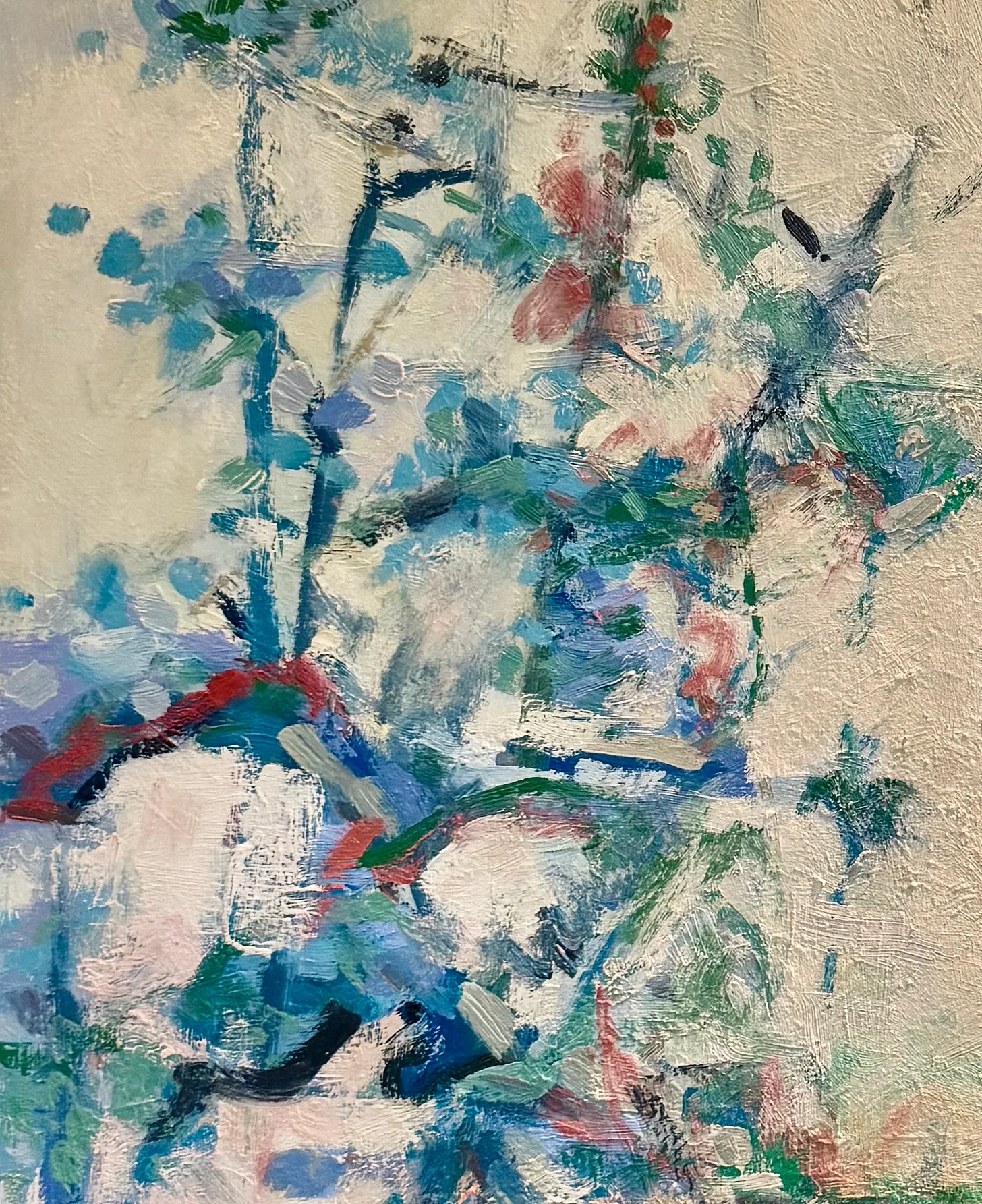
Control and Chaos: A Dialogue with Paint
“ All painting is an accident. But it's also not an accident, because one must select what part of the accident one chooses to preserve."
— Francis Bacon
It took decades of painting to arrive at a simple realization: the paint isn't something I should be bossing around. Somewhere along the way, I came to see it as having opinions of its own, and that we could work as collaborators rather than one of us dictating to the other. I used to try to force it into doing exactly what I intended. Now I let it push back.
That's easier to say than to actually do, though. My instinct is still to control it. When a mark goes down in an unexpected way, the first impulse is to correct it, cover it, force the painting back to what I had in my head. I don't always manage to resist that. Plenty of paintings still end up overworked because I couldn't let something unplanned just stay unplanned. I don't think I'm alone in this. It's a struggle I hear from other artists too, that pull to smooth over what the paint does on its own, to make the whole thing behave.
Most of us know Bob Ross’s expression “happy accidents." I like that because it assumes the accident was worth having in the first place, and I'm not always generous enough with my own work to believe that in the moment. Loosening my grip isn't a switch I flipped once; it's something I have to keep choosing, painting after painting, and I still get it wrong more often than I'd like.
And when I do manage it, the paint pushes back in its own terms, pooling somewhere unplanned, drying differently than expected, settling just slightly off from where I put it. I've stopped treating that as a problem to fix. It's just part of the material, as real as the pigment itself.
That tension isn't really about painting, though. It's the same thing that happens anytime an intention runs into the world's own momentum. You decide on something, and reality has a way of talking back, rearranging your terms before you've finished setting them. Painting has become a small, contained place to practice that: put something down, then actually deal with what resists it, instead of pretending it isn't there.
So each painting ends up as a kind of record of that back and forth, between me, the paint, and whatever we're both circling. Neither of us gets the final say. What's left on the canvas is whatever we settled on somewhere between control and chaos, imperfectly, and not without a fight.
Detail with unplanned moments