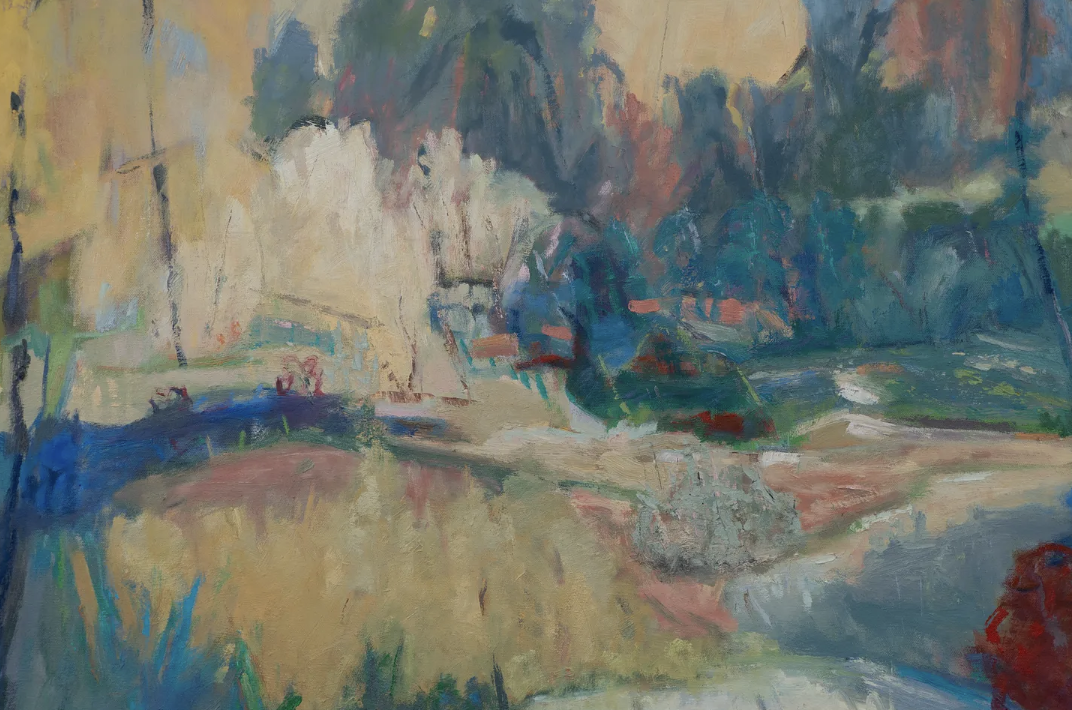
On Letting Go of the Landscape: An Abstract Artist’s Evolving Creative Practice
I’m updating the language on my website, and the task has turned out to be harder than it should be. Every description defaults to the same phrase: “abstracted landscapes.” It’s the term I’ve used since I left landscape painting behind, and sitting down to either keep it or change it forced me to actually ask what it’s doing there.
For a long time, I called my paintings “abstracted landscapes.” It was honest enough at first — I’d come from landscape painting, and as color and gesture started to matter more than where the trees stood, the term still pointed back to where I’d been. It was a bridge term, letting me cross from one way of working into another without having to explain, even to myself, what I’d arrived at. But a bridge is not where you’re supposed to live.
The term made the work safe. Not safe in the sense of timid, but safe in the sense that it told the viewer what to do with their eyes before they’d had a chance to use them. “Abstracted landscape” hands the viewer a key and tells them which door it opens — somewhere in here is a field, a tree line, a sky, if you look hard enough. And once someone has a key, they stop noticing the room.
I don’t want to hand out keys anymore.
This is harder to admit than I expected, because the term wasn’t dishonest. The landscape is in there, sedimentary — in how I think about light, scale, weather. But influence is not subject matter, and I let “landscape” do the job of subject matter long after the work had stopped being about a place. What’s actually driving the paintings now is emotion, memory, history — not memory of a specific field, but a feeling that returns without an image attached, a history that belongs to a body, not a place. None of that needs a horizon to be legible. “Abstracted landscape” kept sending people looking for a place when what was on the canvas was something that happened to a person.
What I want instead is for the viewer to arrive with nothing handed to them — no genre, no permission slip that says it’s fine, this is a field, you can relax. I want them to decide, on their own terms, what they’re looking at. That’s a real decision only if I haven’t already answered it for them. The moment I supply the answer, there’s nothing left for them to find.
There’s a discomfort in this I won’t paper over. Refusing the term doesn’t give me a better one. “Abstract painting” alone feels too broad, as if the absence of representation were the interesting part, when it isn’t. But I’d rather sit in that discomfort honestly than retreat into a phrase that was only ever meant to get me across a bridge.
So I’m letting it go — not because the landscape wasn’t real, but because the word stopped describing the work and started managing the viewer. What’s left is just the painting and whoever is standing in front of it, with no one in the room telling either of them what to think.
That’s the trade I want to make.